Carraway Park
The Pale HorseCarraway Park is the setting for Mark Easterbrook’s planned approach to Mrs Tuckerton, Thomasina Tuckerton’s stepmother. The visit turns an old house into a practical pretext: Mark can present himself as an interested historian, while Ginger’s proposed conversation about the Pale Horse offers a way to watch Mrs Tuckerton for signs of guilt. The house’s scale and its unexpectedly ordinary occupant give the scene a tension between appearance and the purpose of the inquiry.
The House and Its Approach
Ginger advises Mark to use some feature of Mrs Tuckerton’s house as his reason for calling. As an old building, it should sound plausible as a subject for a historian, even though Mark objects that its history is outside his own period. Ginger counters that Mrs Tuckerton is unlikely to know the distinction. She suggests that he might ask about the house or its pictures, then turn the conversation to Thomasina and, abruptly, the Pale Horse. The visit is therefore conceived not as architectural research for its own sake but as a controlled opportunity to observe a response.
When Mark arrives, Carraway Park does not match his preconception of a Nash house. He finds it more like a modest-sized castle, an impression that makes the actual approach feel imposing without establishing the place as sinister. Ginger had promised to provide him with a recent book on Nash architecture, but it has not arrived. Mark is consequently left to conduct the visit with less preparation than he wanted: he has a persuasive general identity as a historian, but not the architectural briefing that might have made his pretext more secure.
The Entrance and Interior
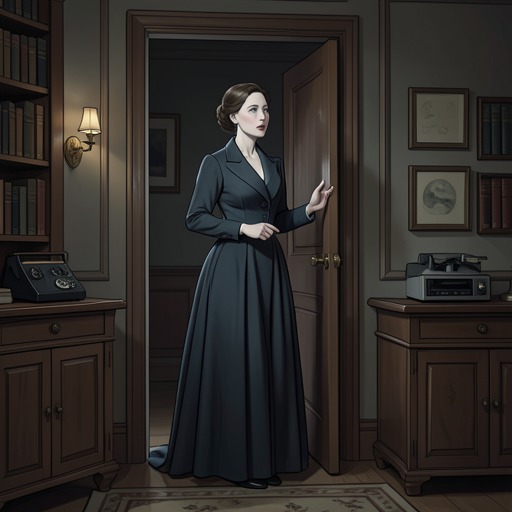
A shabby-looking man in an alpaca coat opens the door and confirms that Mrs Tuckerton is expecting Mark. The brief exchange takes him from the house’s castle-like exterior into an elaborately furnished drawing room. That transition replaces the suggestion of imposing architecture with a different kind of display: the room is expensive, but Mark judges its contents to have been selected without taste. In his assessment, its proportions could have made it pleasant if left alone.
The furnishings sharpen that impression through contrast. There are a few good pictures among many bad ones, and yellow brocade appears in abundance. Mark is seated so deeply in a bright yellow brocade sofa that he has difficulty getting up when Mrs Tuckerton arrives. The room is thus not merely a backdrop for the planned conversation: its conspicuous expenditure, indiscriminate pictures, and repeated yellow fabric give Mark concrete details to register while he waits. The disordered mixture of quality and excess is also distinct from the architectural interest that brought him there as a pretext.
Mrs Tuckerton’s Welcome
Mark’s first impression of Mrs Tuckerton reverses whatever expectation he had formed before meeting her. He sees no immediate sinister figure, but an ordinary young-to-middle-aged woman whom he finds neither particularly interesting nor especially agreeable. His description focuses on her thin-looking, bad-tempered lips despite their lipstick, her slightly receding chin, and pale blue eyes that seem to him to appraise the price of things. He associates her appearance with stinginess toward porters and cloakroom attendants, extending the impression from her face to a recognizable social manner. These are Mark’s judgments, not independent confirmation of her character or guilt.
Mrs Tuckerton, by contrast, is plainly pleased by the call. She gushes over meeting Mark and is delighted that a historian has taken an interest in the house. She says her husband had told her it was built by John Nash, though she had not realized that this would interest someone like Mark. Her welcome validates Ginger’s choice of pretext: Mrs Tuckerton accepts the connection between Mark’s profession and the old house without requiring him to demonstrate specialist knowledge. The promised book’s absence therefore matters less to the opening of the visit than Mark had feared.
Role in the Inquiry
Carraway Park makes the planned test of Mrs Tuckerton possible by providing Mark with a socially acceptable reason to meet her. Ginger’s scheme depends on presenting the visit as friendly and then introducing the Pale Horse unexpectedly, so that Mark can observe whether Mrs Tuckerton appears troubled. The supplied scene establishes that plan and the conditions of the meeting; it does not establish what happens when the subject is raised or what her reaction might be.
The location’s significance rests in this gap between the visit’s outward form and its investigative purpose. Mark arrives as a historian interested in a Nash house, is received by a woman pleased to entertain that interest, and enters rooms whose costly furnishings invite his scrutiny. Beneath this ordinary social exchange lies Ginger’s proposed test. Carraway Park is not shown yielding an answer, but it gives the inquiry a stage on which a casual architectural conversation could become a probe.